
Sensors and Actuators
If a computer is to be used as a
decision maker, a few additions are needed. First, the inputs must be converted to signals that can be
used by the computer. For instance,
a sensor may generate a voltage proportional to the light intensity. This voltage must be converted to a
digital value. In this case, the
converter is an analog-to-digital converter (ADC).
Similarly, the outputs must be
converted to signals that can be used to operate the actuators. Relays are commonly used to switch
heavy loads such as pumps and heaters.
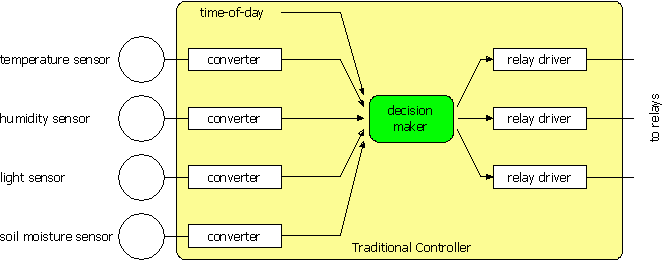
Traditional controllers support
a given number of certain sensors.
This has two obvious disadvantages to this approach.
1.
The number of sensors needed varies from one
implementation to another, whereas the controller supports a fixed number of
inputs. Similarly, the number of
outputs are fixed, while different applications require different number of
outputs.
2.
Implementations cannot use sensors that are not supported,
even if it makes a lot of sense in that particular application.
The iNetGrow Approach
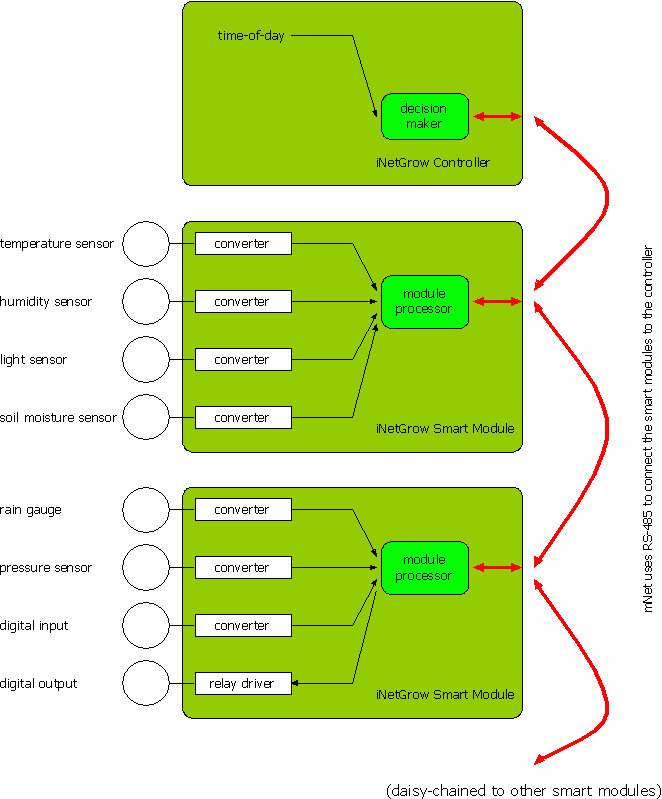
The iNetGrow approach uses smart
modules between the sensors and the controller. The modules are called “smart” because each module has its
own processor. The modules are
connected to the controller via a local RS-485 network called the mNet. The controller is also connected to
mNet, thereby gaining access to the inputs (and outputs).
The iNetGrow approach has
obvious advantages.
1.
The number of inputs and the number of outputs are not
fixed. More inputs and outputs may
be added by connecting more smart modules to mNet. You may select the smart modules to provide the desired
number of inputs and outputs.
2.
The type of sensors is not fixed. Any sensor can be supported by building
a corresponding smart module. This
allows iNetGrow to support even future sensors that are not currently
available. In fact, the C-Series smart
modules are custom modules developed for such cases.
3.
In addition, the smart modules perform much of the
preliminary information processing, such as error detection and correction,
data filtering, unit conversions, etc.
This reduces the load on the central controller.
4.
The system reliability and performance is increased
because more possessors are operating concurrently for the given tasks.
5.
Modules may be moved or swapped, as the application needs
change. This flexibility reduces
cost when the operating mode or the product is changed.
Also see the sections “iNetGrowX” and “Integrating with Web
Services.”
1.
What is Agricultural Control?
4.
Ethernet and Internet Protocols
5.
Pictures of Sample Implementations

© Rigel Corporation iNetGrow 2003-2006. All rights reserved.