

mNet
Each Apopka Controller has its own network, mNet, which allows it to communicate with it's smart I/O modules and allows the modules to communicate with each other. Each controller and its smart I/O modules are collectively referred to as a control unit.
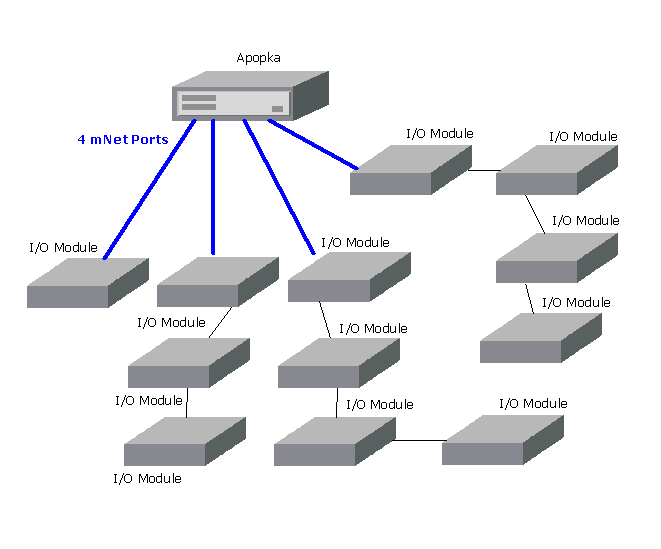
The mNet uses a RS-485 multi-drop protocol, which allows the I/O modules to be daisy-chained. The actual location of a module in a chain, or the actual controller socket to which the chain is connected to is immaterial. This lower level of networking introduces a tremendous level of flexibility and expandability. The modules provide a level of generalization that isolates the specific hardware aspects of a module from the controller. The communications over the mNet are logical messages, not hardware-specific signals. This allows new types of modules to be implemented without having to modify the existing mNet architecture.
Each Apopka Controller has four (4) mNet ports. Each of the four ports can have up to four smart I/O modules connected to it. (see diagram) This gives a total of up to 16 smart I/O modules which can be used with each controller.
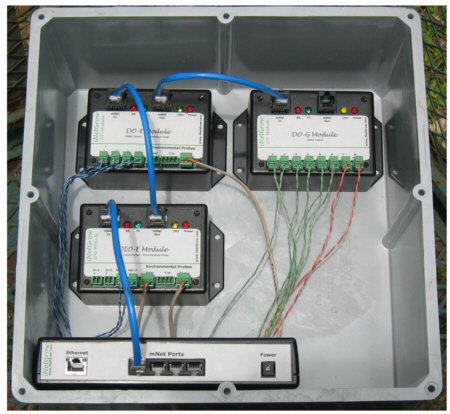
The mNet cables conduct signals and power. When the I/O Modules are daisy-chained, they receive power from the upstream modules, and eventually from the controller. In addition, each I/O module has a power plug. If a power supply is attached to a I/O module, it disconnects the power input from the upstream. Power to that module and all the downstream modules are then provided by the newly inserted power supply (Power Supply.)
© 2003-2006 Rigel Corporation, all rights reserved.