Architecture
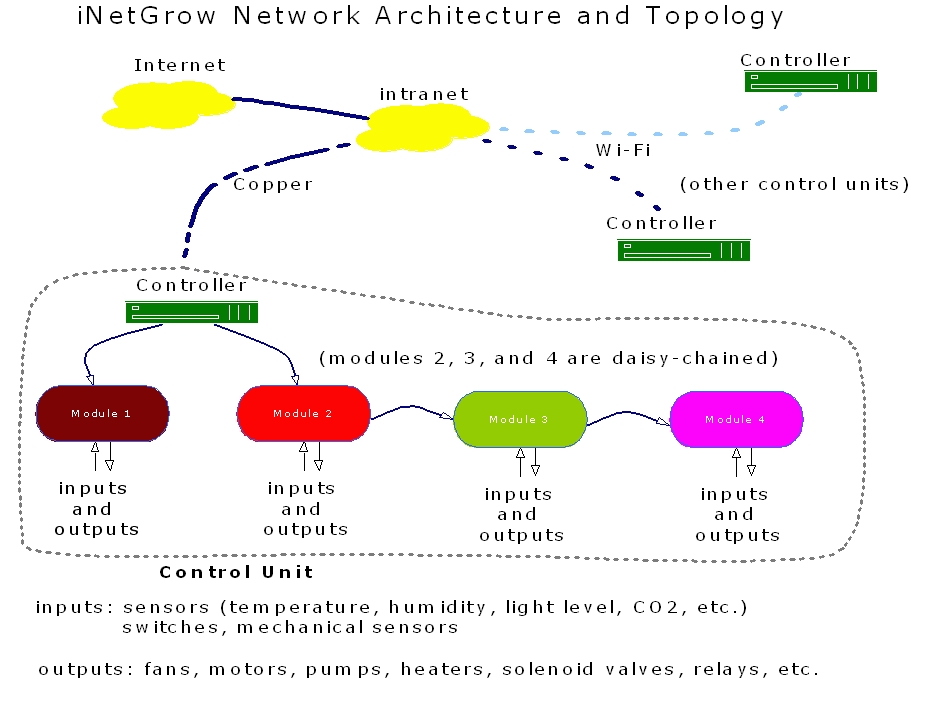
The iNetGrow architecture (see diagram or sample
implementation) treats each controller as a peer device with its own IP
address on the LAN. Each
controller has one or more modules.
Each module has several inputs and outputs. A controller and its I/O modules collectively are referred
to as a control unit (see diagram and concepts).

Each control unit has the
capability to automate its control tasks and log local data. Moreover, any unit is accessible
through the LAN using one or more PCs.
Each PC may monitor and control the units, log their data, update web
pages with information collected from the units, or generate e-mail messages
containing data collected from the units.
Being on the LAN, any PC may access any unit, provided that the security
criteria (e.g. passwords) are met.
PC access is provided through the software
(iNetGrow.exe).
A Two-Echelon Architecture
The iNetGrow architecture is
actually built over two levels of networking. The control units are connected through a standard Ethernet
LAN. However, under each controller,
there is a local module network, referred to as mNet, which carries the
communications between the controller and the smart I/O modules. mNet has a multi-drop protocol, which
allows smart I/O modules to be daisy-chained. The actual location of a module in a chain, or the actual
controller socket to which the chain is connected is immaterial. I/O modules are addressed by logical
addresses, rather than physical addresses. This lower level of networking introduces a tremendous level
of flexibility and extensibility.
The modules provide a level of generalization that isolates the specific
hardware aspects of a module from the controller. The communications over mNet are in logical messages, not
hardware-specific signals. This
allows new types of modules to be implemented without having to modify the
existing mNet architecture.
Similarly, the controllers encapsulate all tasks of a control unit in a
manner, which is accessible over the LAN.
Once again, control units may freely be added to the LAN without having
to consider any hardware-specific aspects. Moreover, LAN messaging is conducted using standard Internet
protocols, further simplifying PC access to the control units.

© Rigel Corporation iNetGrow 2003-2006. All rights reserved.